Poison Dart Frog Habitat: Where Do Poison Dart Frogs Live?
Where do poison dart frogs live? The short answer is: in the warm, humid forests of Central and South America. But the real answer is much more interesting, because each species lives in its own tiny world, from the leaf litter of the forest floor to little pools of water hidden in the treetops. At Somos Pacífico we live in the heart of one of their most important homes, the Chocó rainforest of Colombia, so let us show you around.
Poison dart frog habitat at a glance
- Region: Central and South America, from Nicaragua to Bolivia and southern Brazil
- Ecosystems: lowland tropical rainforests, cloud forests and, for a few species, forest patches surrounded by savanna
- Elevation: from sea level to the mountains; many species live below 1,000 meters
- Climate: warm and very humid, often 22 to 30°C (72 to 86°F) with humidity close to 80 to 100%
- Microhabitat: leaf litter, roots, fallen logs, rocks near streams, bromeliads and tree holes
- Hotspot: the Chocó rainforest of Colombia’s Pacific coast, home to the most poisonous frogs on Earth
Where in the world do poison dart frogs live?
Poison dart frogs live only in the Neotropics: the tropical Americas. Their range starts in Nicaragua, runs through Costa Rica and Panama, and covers much of northern South America, including Colombia, Ecuador, Peru, Venezuela, the Guianas, Brazil and Bolivia. The only population outside this range lives in Hawaii, where the green and black poison dart frog was introduced in 1932.
Within that huge area, though, most species have very small ranges. Some live in just a few valleys, a single mountain slope or a handful of forest patches. That is why so many of them are vulnerable to deforestation.
The Chocó: the home of the deadliest frogs
If poison dart frogs have a capital, it is the Chocó biogeographic region, a strip of rainforest along the Pacific coast of Colombia, extending into Panama and Ecuador. This is where we live and work at Somos Pacífico, and it is a truly extraordinary place:
- It is one of the rainiest places on Earth. Some towns in the Colombian Chocó, like Lloró, are often listed among the wettest places on the planet, with estimates of more than 12,000 mm (about 470 inches) of rain a year.
- It is one of the richest in species. Its isolated river valleys, separated by the Andes on one side and the ocean on the other, have produced an enormous number of plants and animals found nowhere else.
- It is home to the three deadliest frogs in the world: the golden poison frog, the black-legged poison frog and the Kokoe poison frog. See them in our list of the most poisonous frogs in the world.
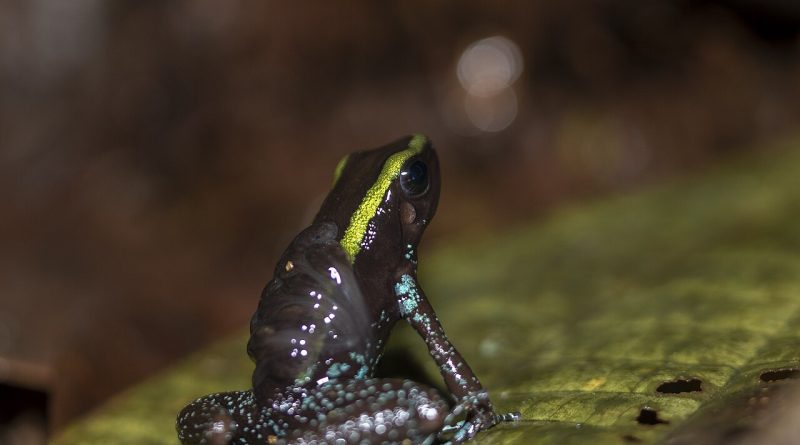
The frog in the photo at the top of this article is a Kokoe poison frog (Phyllobates aurotaenia), photographed in Utría National Natural Park, on the Chocó coast near Bahía Solano. Look closely: it is carrying its newly hatched tadpoles on its back, on their way to a pool of water. If you want to visit the area, read our guide to Bahía Solano, Colombia.
Each species, its own little world
Here are some examples of how different poison frog habitats can be:
- Golden poison frog: the lowland forest floor of Colombia’s Pacific coast, from sea level to about 200 meters, with more than 5 meters of rain a year.
- Kokoe poison frog: humid forest floors in the Atrato and San Juan river basins, roughly between 60 and 520 meters.
- Harlequin poison frog: rainforests of the upper San Juan River region, between about 300 and 700 meters.
- Blue poison dart frog: small islands of humid forest inside the Sipaliwini savanna of Suriname. Read more about the blue poison dart frog.
- Bumblebee dart frog: forests of Venezuela and nearby countries up to 800 meters, including patches that dry out seasonally. It survives the dry season by going dormant. Read more about the bumblebee dart frog.
- Strawberry poison dart frog: lowland forests on the Caribbean side of Central America, and on the islands of Bocas del Toro, Panama, each with its own colors. Read more about the strawberry poison dart frog.
Life on the forest floor
Most poison dart frogs spend their days on the ground, moving through the leaf litter, between roots, rocks and fallen logs. This is where they find the ants, mites and tiny beetles that give them their toxins. Many of them stay close to small streams or wet spots, because their thin skin dries out easily. Because they are protected by their poison, they don’t need to hide: unlike most frogs, they are active during the day.
Nurseries in the treetops
One of the most fascinating parts of their habitat is above our heads. After their eggs hatch on land, many poison frogs carry their tadpoles on their backs up into the trees, and drop them into tiny pools of water: the center of a bromeliad, a hole in a branch, even an empty Brazil nut shell. These little pools are safer than streams, where fish and other predators lurk. Some mothers, like the strawberry frog, keep visiting to feed their tadpoles with unfertilized eggs.
Threats to their habitat
Because so many species live in small areas, losing even a few hectares of forest can wipe out a population. The main threats are deforestation for cattle ranching and agriculture, illegal mining, illegal crops and the capture of wild frogs for the pet trade. In Colombia, several species are listed as Endangered or Critically Endangered, and conservation groups have created reserves to protect them, such as the Rana Terribilis Amphibian Reserve for the golden poison frog.
Recreating their habitat at home
People who keep captive-bred dart frogs try to recreate a small piece of rainforest in a terrarium, called a vivarium: high humidity, live plants, bromeliads, leaf litter, a stable temperature and lots of hiding spots. It is a fun way to understand how these frogs live, as long as the animals come from responsible breeders and never from the wild.
Frequently asked questions
Do poison dart frogs live in the Amazon?
Yes. Many species live in the Amazon rainforest of Brazil, Peru, Ecuador, Colombia and Bolivia. But the most poisonous species live elsewhere, in the Chocó rainforest of Colombia’s Pacific coast.
Do poison dart frogs live in trees?
Most live on the forest floor, but they are good climbers. Many species climb trees to drop their tadpoles in bromeliads or tree holes, and some spend much of their time above the ground.
Are there poison dart frogs in Africa or Asia?
No. Poison dart frogs live only in the Americas. Other parts of the world have their own colorful toxic frogs, like the mantellas of Madagascar, but they belong to a different family.
Why do poison dart frogs need so much humidity?
Like all amphibians, they breathe partly through their thin skin, which must stay moist. Dry air would dehydrate them quickly, which is why they live in some of the wettest forests on Earth.
Want to learn more? Read our 15 poison dart frog facts.
Sources: IUCN Red List; Wildlife Conservation Society Colombia; World Land Trust; American Museum of Natural History; Animal Diversity Web. Featured video by BBC Earth on YouTube. Featured photo: Biodiego88, CC BY-SA 4.0, via Wikimedia Commons.

Contenido Destacado