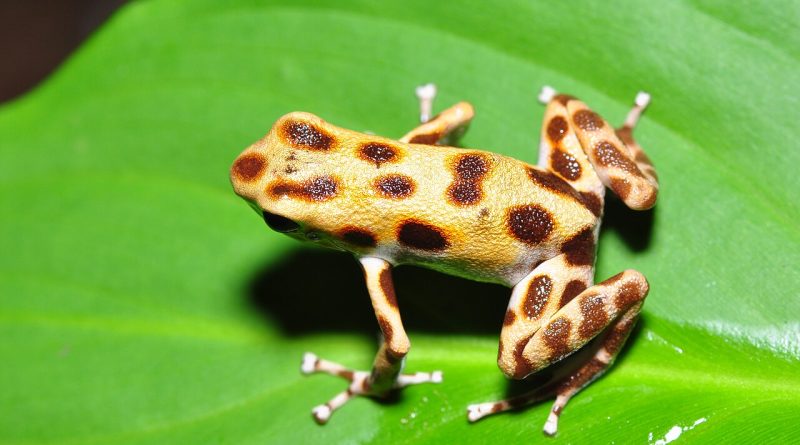
Is the Rainbow Poison Dart Frog Real? The Truth Behind the Viral Photos
You have probably seen it on social media: a tiny frog painted in every color of the rainbow, with stripes of red, orange, yellow, green, blue and purple, usually captioned «the rainbow poison dart frog». It gets millions of likes and shares. But is the rainbow poison dart frog real? At Somos Pacífico we are communicators who live among real poison frogs in the Colombian Chocó, so we checked. Here is the truth.
The short answer: no, it is not a real species
There is no species of poison dart frog called the «rainbow poison dart frog». Scientists have described close to 200 species of poison frogs, and none of them looks like the multicolored frog in those viral images. The perfect rainbow stripes, the bright purple and the smooth color gradients are the work of photo editing or, more and more often, artificial intelligence.
That does not mean colorful frogs are a myth. Nature has produced frogs with amazing colors, and some of them really do look almost like a rainbow. They just look different from the viral pictures.
How to tell if a frog photo is fake
As journalists, we check images every day. These are the signs that a «rainbow frog» picture is not real:
- Too many colors in perfect order. Real poison frogs usually combine two or three colors, such as yellow and black or red and blue. A full red-to-purple spectrum in neat bands is a red flag.
- Smooth color gradients. Real frog colors come in patches, spots and bands with clear edges, not soft blends like a rainbow filter.
- Strange anatomy. AI-generated frogs often have extra or fused toes, odd eyes or skin textures that look like plastic.
- No species name. Real wildlife photos usually say what species it is and where it was taken. Viral fakes almost never do.
- No photographer. If nobody takes credit for the picture, be suspicious.
- Reverse image search. Upload the picture to a reverse image search tool. Fakes often lead to art websites, AI image galleries or edited versions of real photos.
There is another problem with some «amazing» frog photos: even when the frog is real, the scene may be staged. Investigations of viral wildlife photos have found frogs that were bought as pets and posed on other animals or objects for the camera. That can be stressful and harmful for the animals.
The real «rainbow frogs» of the world
If you are looking for real frogs with spectacular colors, here are some that will not disappoint:
1. The strawberry poison dart frogs of Bocas del Toro
This is the closest thing to a real rainbow poison dart frog: not one frog, but a whole species with a rainbow of colors. On the islands of Bocas del Toro, in Panama, almost every island has its own form of the strawberry poison dart frog: red, orange, yellow, green, blue, white, spotted or plain. On Isla Cristóbal, for example, some frogs are so blue that photographers call them «blueberry» frogs. The frog in the photo at the top of this article was photographed on Isla Bastimentos.
2. The dyeing poison dart frog and its many morphs
The dyeing poison dart frog comes in dozens of color forms: yellow and black, blue and black, almost all blue like the famous blue poison dart frog, orange, white… Put them side by side and you get a real rainbow.
3. The harlequin poison frog of the Colombian Chocó
In the rainforests of the upper San Juan River, in western Colombia, lives the harlequin poison frog (Oophaga histrionica). Its spots can be orange, red, yellow or white on a dark background, and it varies so much that almost no two look alike. Sadly, it is Critically Endangered. Meet it and its relatives in our list of the most poisonous frogs in the world.
4. The Malagasy rainbow frog
Here is a real frog that actually carries the name: the Malagasy rainbow frog (Scaphiophryne gottlebei), also called the rainbow burrowing frog. It is not a poison dart frog and it lives far away, in the rocky canyons of the Isalo Massif in southern Madagascar. Its back is covered with patches of red-orange, green, white and black, each color clearly separated. It is only 2 to 4 cm long, it can climb canyon walls at night using small claws, and it is listed as Endangered, partly because thousands were once collected every year for the pet trade.
Why are poison dart frogs so colorful?
Real poison frogs are colorful for a reason. Their bright colors are a warning to predators that they are toxic, a strategy called aposematism. Over thousands of years, isolated populations living in different valleys or islands developed different color combinations, which is why one species can come in so many colors. You can read more in our 15 poison dart frog facts.
Frequently asked questions
Is the rainbow poison dart frog real?
No. There is no species with that name, and the viral images are edited or AI-generated. However, species like the strawberry poison dart frog and the dyeing poison dart frog come in a real rainbow of color forms.
Is there a real rainbow frog?
Yes, the Malagasy rainbow frog (Scaphiophryne gottlebei) from Madagascar. It has red-orange, green, white and black patches, but it is not a poison dart frog and does not look like the viral images.
Are pink or purple poison dart frogs real?
Vivid pink and purple frogs in viral posts are usually edited images. Some real poison frogs have reddish, bluish or violet tones, but bright pink or purple ones in perfect lighting should be treated with suspicion.
What is the most colorful poison dart frog?
As a species, the strawberry poison dart frog is probably the most variable, with dozens of color forms across the islands of Bocas del Toro, Panama. For a single frog, the harlequin poison frog of Colombia and the dyeing poison dart frog are among the most striking.
Sources: IUCN Red List; PBS NewsHour; Animal Diversity Web; Wildlife Conservation Society Colombia. Featured video by Franco Andreone on YouTube. Featured photo: Pavel Kirillov, CC BY-SA 2.0, via Wikimedia Commons.

Contenido Destacado