The Most Poisonous Frogs in the World (The Top 3 Are Colombian)
Which is the most poisonous frog in the world? The answer will surprise many people: the top three all come from the same corner of the planet, the rainforests of Colombia’s Pacific coast. At Somos Pacífico we are based on the banks of the San Juan River, in the heart of this region, and some of the frogs on this list live right here.
Here is our list of the most poisonous frogs on Earth, what makes each one special, and why none of them can hurt you if you see them in a zoo.
How do you measure how poisonous a frog is?
Rankings of «the most poisonous frogs» are never exact. Toxicity changes from one population to another, and even from one frog to another, because these frogs don’t produce their own poison. They absorb it from the ants, mites and small beetles they eat in the wild. That is also why frogs raised in captivity, fed on fruit flies and crickets, are not poisonous at all.
What scientists can say is which type of toxin each species carries and how powerful it is. And on that point there is no debate: the frogs of the genus Phyllobates, which carry batrachotoxin, are in a league of their own.
1. Golden poison frog (Phyllobates terribilis)
The undisputed champion. A single wild golden poison frog carries about one milligram of batrachotoxin, commonly described as enough to kill around ten people. It is also the largest poison dart frog, at about 5 to 6 cm, and comes in yellow, orange and mint green.
- Where: lowland rainforest of Cauca and Valle del Cauca, Colombia
- Toxin: batrachotoxin
- Status: Endangered (IUCN)
We wrote a full guide about it: Golden Poison Frog: The Most Poisonous Frog on Earth Lives in Colombia.
2. Black-legged poison frog (Phyllobates bicolor)
Often described as the second most toxic frog in the world. It looks like a smaller cousin of the golden poison frog: a yellow or orange body with black or dark blue legs, which gives it its name. Males reach about 4.5 to 5 cm and females are slightly larger.
- Where: rainforests of Chocó, Valle del Cauca and Risaralda, Colombia
- Toxin: batrachotoxin
- Status: Endangered (IUCN), threatened by mining, cattle ranching and illegal crops
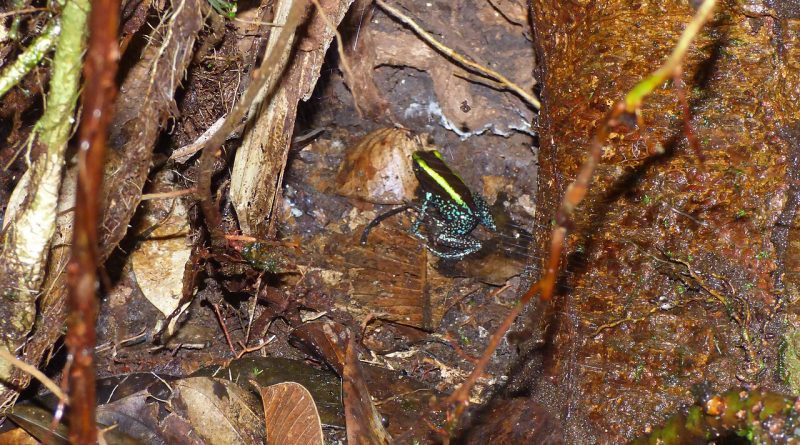
3. Kokoe poison frog (Phyllobates aurotaenia)
This is the one closest to home. The Kokoe poison frog lives in the forests of the Atrato and San Juan river basins in the Chocó, the same rivers that shape life in our region. It is frequently listed as the third most poisonous frog in the world, and it is the smallest of its genus: a black frog with bright stripes along its sides that can be yellow, orange, green or gold, and a black belly speckled with blue or green.
According to historical accounts, Indigenous hunters of the upper San Juan would find these frogs by imitating their call, and used their poison on the tips of their blowgun darts. Together with the golden and black-legged frogs, it is one of only three species known to have been used for poison darts. In other words, the name «poison dart frog» was born in this corner of the Chocó.
- Where: Atrato and San Juan river basins, Chocó, Colombia (about 60 to 520 m above sea level)
- Toxin: batrachotoxin
- Status: Least Concern (IUCN), although its numbers are declining due to habitat loss
4. Harlequin poison frog (Oophaga histrionica)
Every harlequin frog looks different: brown backgrounds with bright spots in orange, red, yellow or white, like a costume, which explains the name. Its skin contains histrionicotoxins, named after this very species, which act on the nervous system. It is smaller than the Phyllobates, about 3.3 cm on average.
- Where: rainforests of the upper San Juan River region, western Colombia
- Toxin: histrionicotoxins
- Status: Critically Endangered (IUCN), mainly due to mining-related deforestation and the illegal pet trade
5. Lehmann’s poison frog (Oophaga lehmanni)
Black with bold red or orange bands, Lehmann’s poison frog is one of the rarest frogs in the Americas. Its whole known range is smaller than 10 square kilometers, in the Western Andes of Colombia near the Anchicayá River and the Farallones de Cali National Park. Because of illegal trafficking, it is protected under CITES Appendix II.
- Where: Western Andes, Valle del Cauca, Colombia
- Toxin: alkaloids typical of the genus Oophaga
- Status: Critically Endangered (IUCN)
6. Phantasmal poison frog (Epipedobates tricolor)
The first frog on our list that is not Colombian: it lives in Ecuador. It is tiny and not as deadly as the Phyllobates, but it became famous in medicine. A chemical from frogs of this group, epibatidine, was found to be about 200 times more potent than morphine as a painkiller in laboratory tests. It was too toxic to use as a drug, but it inspired years of research into new pain medicines.
- Where: Andean slopes of Ecuador
- Toxin: epibatidine and other alkaloids
7. Strawberry poison dart frog (Oophaga pumilio)
Red body, often with blue legs, like «blue jeans». The strawberry poison dart frog is far less dangerous than the frogs above, but it has a place in the history of toxicology: pumiliotoxins, a whole family of frog toxins, were named after it. It is also famous for its parenting, as mothers feed their tadpoles with unfertilized eggs.
- Where: Central America, from Nicaragua to Panama
- Toxin: pumiliotoxins and other alkaloids
Why are the most poisonous frogs in Colombia?
The Colombian Pacific is part of the Chocó biogeographic region, one of the rainiest places on Earth and one of the richest in species. High rainfall, warm temperatures and isolated river valleys have created many small, unique populations, each adapted to its own patch of forest and its own prey. Scientists still don’t know exactly which local insect gives the Phyllobates their batrachotoxin, but whatever it is, the three deadliest frogs on the planet all found it in this region.
That richness is also fragile. Most of the frogs on this list are threatened by deforestation, illegal mining and wildlife trafficking. Taking frogs from the wild is illegal in Colombia, and the best way to admire them is in their forest, with a local guide, or through captive-bred animals from responsible breeders.
Frequently asked questions
What is the most poisonous frog in the world?
The golden poison frog (Phyllobates terribilis) from Colombia’s Pacific coast. A single wild frog carries enough batrachotoxin to kill around ten people.
Can a poison dart frog kill you if you touch it?
Most species are dangerous mainly if eaten, but the toxins of the Phyllobates can enter the body through cuts or mucous membranes. With wild frogs, the rule is simple: look, don’t touch.
Are pet poison dart frogs poisonous?
No. Captive-bred frogs don’t have access to the wild insects that provide their toxins, so they are considered non-toxic.
Which poison frogs were used for darts?
Only three species are known to have been used to poison blowgun darts, all from the Colombian Pacific: the golden poison frog, the black-legged poison frog and the Kokoe poison frog.
Sources: IUCN Red List; Wildlife Conservation Society Colombia; American Museum of Natural History; World Land Trust. Featured video by Real Science on YouTube. Featured photo: Daniel van der Post, CC0, via Wikimedia Commons.

Contenido Destacado