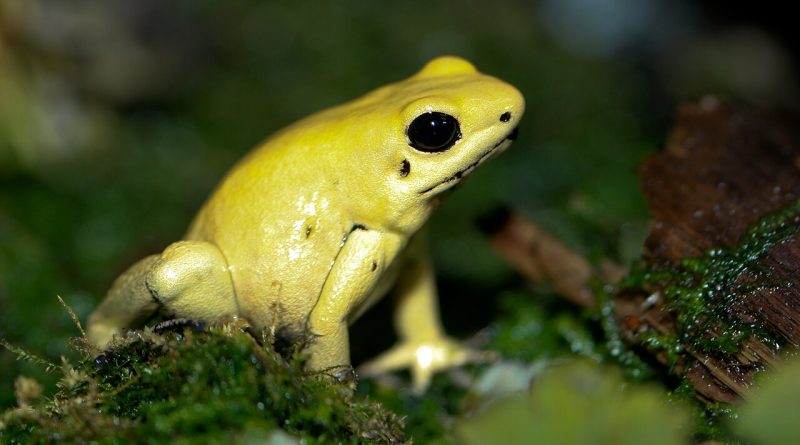
Golden Poison Frog: The Most Poisonous Frog on Earth Lives in Colombia
It is smaller than your thumb, it glows like a piece of gold on the rainforest floor, and it carries enough poison to kill around ten people. The golden poison frog (Phyllobates terribilis) is considered the most poisonous frog on Earth, and it lives in only one place in the world: a small corner of the rainforest on Colombia’s Pacific coast.
At Somos Pacífico we live and work in the Colombian Pacific, the region scientists call the Chocó biogeographic region, one of the rainiest and most biodiverse places on the planet. This is the story of the most famous animal of our forests: what makes it so toxic, why the frogs you see in zoos are harmless, and how Indigenous hunters used its poison for centuries.
Golden poison frog: quick facts
- Scientific name: Phyllobates terribilis («terribilis» means «terrible», a nod to its deadly skin)
- Size: about 5 to 6 cm (2 to 2.4 inches), the largest of all poison dart frogs
- Where it lives: only in the lowland rainforest of the Cauca department, on Colombia’s Pacific coast
- Colors: golden yellow, metallic orange and pale mint green, depending on the population
- Poison: batrachotoxin, one of the most potent natural toxins known
- Conservation status: Endangered (IUCN Red List)
- Described by science: 1978, by Charles W. Myers, John W. Daly and Borys Malkin
How poisonous is the golden poison frog?
A wild golden poison frog carries roughly one milligram of batrachotoxin in glands on its skin. Estimates vary between sources, but that is commonly described as enough to kill around ten adult humans, or more than 20,000 mice. That is why it is widely called the most poisonous frog in the world.
Batrachotoxin works by jamming open the sodium channels of nerve and muscle cells. Once those channels can’t close, nerves can no longer send signals properly, which can lead to paralysis and heart failure. There is no known antidote.
The frog does not bite or sting. The poison is defensive: it sits in the skin, so a predator that tries to eat the frog gets poisoned. Its bright color works as a warning sign that says, simply, «don’t eat me.» Scientists call this aposematism.
Can you touch a golden poison frog?
A wild one, no. The toxin can enter the body through cuts, scratches or mucous membranes, and with this species there is no margin for error. If you are lucky enough to see one in the Colombian rainforest, look and take pictures, but don’t touch it. And never take one from the wild: besides the danger, it is illegal and it harms an endangered species.
Why captive golden poison frogs are not poisonous
Here is the surprising part: the frog does not make its own poison. It gets the toxin from its diet in the wild. Scientists suspect the source is a tiny beetle from the family Melyridae, because a related beetle in New Guinea produces the same toxin, but the exact prey in Colombia has not been confirmed.
Frogs raised in captivity eat fruit flies and crickets instead of their natural rainforest prey, so they never build up batrachotoxin. That is why captive-bred golden poison frogs in zoos and private collections are considered non-toxic. When you hear that someone keeps a «terribilis» at home, this is the reason it is possible.
The Emberá and the poison darts
The name «poison dart frog» comes from the Pacific rainforest. The Emberá, an Indigenous people of the Colombian Pacific, used the poison of Phyllobates frogs to tip the darts of their blowguns for hunting. According to published accounts, hunters gently warmed the frog so it would release the poison through its skin, then coated their dart tips in it. Darts prepared this way could stay deadly for a long time, by some accounts two years or more.
Of the roughly 170+ species of poison frogs, only a few in the Phyllobates genus are known to have been used this way, and the golden poison frog is the most famous of them. It is a piece of knowledge born in the forests of the Colombian Pacific, long before the frog had a scientific name.
Where does the golden poison frog live?
Its whole natural range covers less than 5,000 square kilometers of lowland rainforest in the Cauca department, on Colombia’s Pacific coast, from sea level up to about 200 meters. It is part of the great Chocó rainforest, an ecoregion that stretches along the Pacific from Panama to Ecuador.
It is a hard place to live for most species, but perfect for this frog: more than 5 meters (about 200 inches) of rain a year, temperatures of at least 26°C (79°F) and humidity between 80 and 90%. Unlike many tree frogs, the golden poison frog lives on the forest floor, hunting ants and other small insects among the fallen leaves.
The three colors of the golden poison frog
Despite its name, not every golden poison frog is golden. Scientists recognize three main color forms in the wild:
- Yellow: from pale yellow to deep golden. This is the classic look.
- Orange: metallic orange or yellow-orange, found in some of the same areas as the yellow frogs.
- Mint green: metallic or pale green, almost white. The mint form tends to be the largest.
Young frogs look completely different: they are mostly black with two golden stripes on their backs, and they only reach their full adult color at around four months old.
Golden poison frog parents carry their babies on their backs
Males call females with a trilling song. The female lays her eggs on the ground, under the leaf litter. When the tadpoles hatch, they wriggle onto a parent’s back and are carried up into the trees, where they are dropped into small pools of water held by bromeliads and tree holes. There they grow, feeding on algae and mosquito larvae, until they become tiny frogs.
Is the golden poison frog endangered?
Yes. The IUCN lists it as Endangered. Its tiny range makes it very vulnerable, and its forest is under pressure from logging, gold mining, agriculture and illegal crops. In the past, collection for the pet trade was also a problem; today most frogs in the trade are captive-bred.
There is good news too. In 2012 the Colombian NGO Fundación ProAves, with support from the UK charity World Land Trust, created the Rana Terribilis Amphibian Reserve, the first protected area dedicated to this species.
Frequently asked questions
Is the golden poison frog the most poisonous animal in the world?
It is usually called the most poisonous frog, and it is among the most poisonous animals on Earth. Rankings depend on how «poisonous» is measured, but few animals carry such a potent toxin in such a small body.
Does the golden poison frog have any predators?
Adults have almost none. The exception is a small snake, Leimadophis epinephelus (now often placed in the genus Erythrolamprus), which resists the toxin and has been seen eating young frogs.
Is the golden poison frog from Chocó?
It lives in the Chocó rainforest ecoregion, but within the Cauca department, not the Chocó department. The Colombian Pacific is home to many other spectacular poison frogs, which we will cover in this series.
Can I buy a golden poison frog?
Captive-bred golden poison frogs are sold legally by specialized breeders in some countries. Never buy a frog that may have been taken from the wild: it fuels wildlife trafficking and puts an endangered species at risk.
Sources: IUCN Red List; World Land Trust; National Geographic; Aquarium of the Pacific; Myers, Daly & Malkin (1978), Bulletin of the American Museum of Natural History. Featured video by Into the Shadows on YouTube. Featured photo: Brian Gratwicke, CC BY 2.0, via Wikimedia Commons.

Contenido Destacado