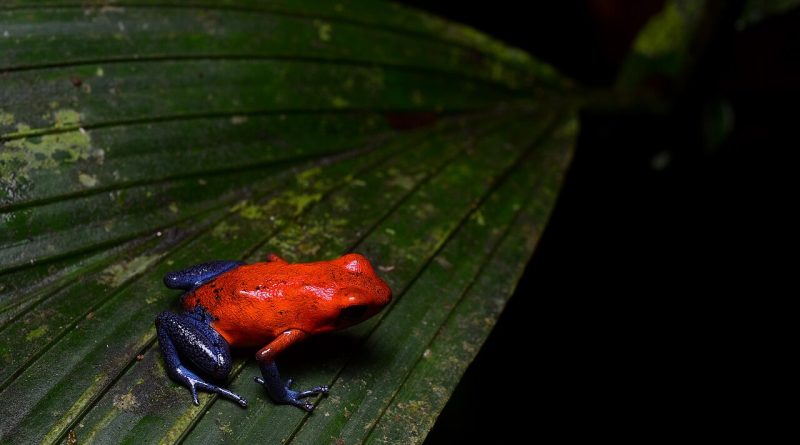
Strawberry Poison Dart Frog: The Tiny Frog That Feeds Its Babies Eggs
Red as a strawberry, often with blue legs that look like a pair of jeans, and smaller than a fingernail: the strawberry poison dart frog is one of the most charming animals of the Central American rainforest. It is also one of the most surprising, because few frogs in the world are such dedicated mothers. At Somos Pacífico, from the land of Colombia’s poison frogs, we tell you all about it.
Strawberry poison dart frog: quick facts
- Scientific name: Oophaga pumilio (formerly Dendrobates pumilio)
- Other names: strawberry poison frog, «blue jeans» frog
- Size: about 17 to 24 mm (0.7 to 0.9 inches)
- Where it lives: lowland rainforests of Nicaragua, Costa Rica and Panama
- Diet: mainly ants and mites
- Toxins: pumiliotoxins and other alkaloids
- Conservation status: Least Concern (IUCN)
Where does the strawberry poison dart frog live?
It lives on the Caribbean side of Central America, in the humid lowland forests of Nicaragua, Costa Rica and Panama, from sea level up to several hundred meters. You can find it on the forest floor, among fallen leaves, roots and plants, and it is often easy to spot because it is active during the day and males call loudly to defend their small territories.
A frog with dozens of colors
«Strawberry» is just its most famous look. The strawberry poison dart frog is one of the most variable frogs on Earth. In Costa Rica and Nicaragua it is usually red with blue or black legs, the classic «blue jeans» look. But in the Bocas del Toro islands of Panama, almost every island has its own color form: red, orange, yellow, green, blue, white, black, spotted or plain. Scientists study these frogs to understand how new colors, and maybe new species, appear.
Is the strawberry poison dart frog poisonous?
Yes, wild ones are toxic. In fact, an entire family of frog toxins, the pumiliotoxins, was named after this species. Its toxins come mostly from the ants and mites it eats. They are strong enough to make predators sick, but this frog is much less dangerous to people than the deadly Phyllobates of the Colombian Pacific. Compare them in our list of the most poisonous frogs in the world.
As with all poison dart frogs, captive-bred strawberry frogs fed on fruit flies and springtails do not develop toxins.
The most devoted mother in the rainforest
This is what makes the strawberry poison dart frog famous among biologists. The process goes like this:
- Eggs on land. The female lays a small clutch, usually 3 to 5 eggs, on a leaf on the forest floor.
- Dad on guard. The male watches over the eggs for about 10 to 14 days, keeping them moist and cleaning them.
- Piggyback ride. When the tadpoles hatch, the mother carries them on her back, one at a time, up to tiny pools of water inside bromeliads and other plants. Each tadpole gets its own pool.
- Room service. Over the following weeks, the mother visits each tadpole and lays unfertilized eggs in its pool. These eggs are the tadpole’s food.
The tadpoles depend completely on their mother: if she doesn’t come back to feed them, they starve. It is the reason for the genus name Oophaga, which means «egg eater». The young frogs leave the water after several weeks and reach adulthood at about 10 months.
Scientists think that the eggs may also pass some of the mother’s toxins to the tadpoles, giving them protection from the very start of their lives.
Small but tough: territorial males
Male strawberry frogs defend tiny territories, often just a few square meters, with short, chirping calls. When an intruder ignores the warning, they wrestle, sometimes for many minutes, until one gives up and leaves.
Its Colombian relatives
The strawberry frog does not live in Colombia, but its genus Oophaga does. The harlequin poison frog (Oophaga histrionica), from the upper San Juan River region, and Lehmann’s poison frog (Oophaga lehmanni) are two of its Colombian cousins. Sadly, both are Critically Endangered, threatened by deforestation and wildlife trafficking.
Frequently asked questions
How big is a strawberry poison dart frog?
Very small: adults measure about 17 to 24 mm, less than an inch.
Can you touch a strawberry poison dart frog?
It’s best not to touch wild ones. Their toxins are not usually deadly to people, but they can irritate your skin or eyes, and handling stresses the frog.
Are strawberry poison dart frogs good pets?
They are beautiful but considered a species for experienced keepers, because breeding them requires bromeliads and a mother able to feed her tadpoles. Always choose captive-bred frogs.
Why is it called the «blue jeans» frog?
Because many populations in Costa Rica and Nicaragua have a red body with blue legs, as if wearing a pair of jeans.
Want more? Read our 15 poison dart frog facts.
Sources: Animal Diversity Web (University of Michigan); IUCN Red List; Wildlife Conservation Society Colombia. Featured video by National Geographic on YouTube. Featured photo: Geoff Gallice, CC BY 2.0, via Wikimedia Commons.

Contenido Destacado