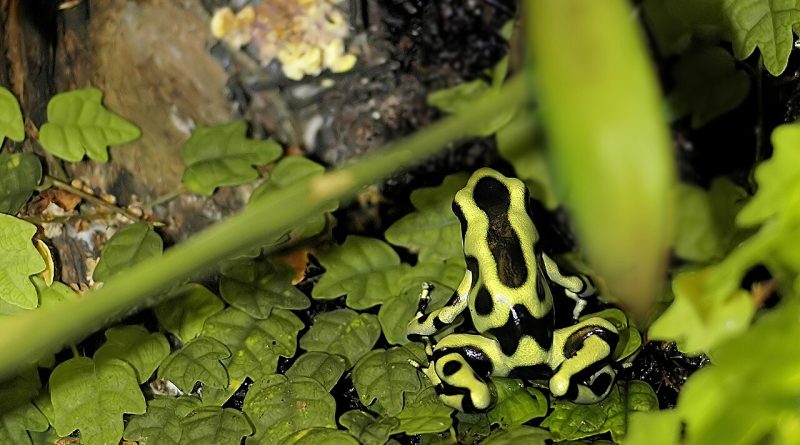
Green and Black Poison Dart Frog: From Colombia to Hawaii
Metallic green and black, as if painted by hand, the green and black poison dart frog is one of the most widespread poison frogs in the Americas. It lives from Nicaragua all the way to Colombia, and it is also the only poison dart frog that has made a home in Hawaii. At Somos Pacífico, from Colombia’s Pacific, we tell you all about this traveling frog.
Green and black poison dart frog: quick facts
- Scientific name: Dendrobates auratus
- Size: about 2.5 to 4 cm (1 to 1.6 inches)
- Where it lives: lowland rainforests from Nicaragua through Costa Rica and Panama into northwestern Colombia; introduced to Oahu, Hawaii
- Diet: small invertebrates, especially ants
- Active: during the day
- Lifespan: about 8 years on average in captivity, sometimes much longer
- Conservation status: Least Concern (IUCN); listed in CITES Appendix II
Where does the green and black poison dart frog live?
Its native home is the humid lowland forest of Central America and northwestern South America: Nicaragua, Costa Rica, Panama and Colombia, where it reaches the forests close to the border with Panama. It lives on the forest floor, usually near small streams or pools, and it is also a good climber.
That makes it the closest relative of the famous blue and dyeing dart frogs that you can find in Colombia. Its Dendrobates cousins live far away, in the Guianas, as we explain in our guides to the dyeing poison dart frog and the blue poison dart frog.
The poison dart frogs of Hawaii
Here is a story few people know. In 1932, 206 green and black poison dart frogs were brought from an island off the Pacific coast of Panama and released in the upper Manoa Valley, on the island of Oahu. The goal was to control non-native insects, including mosquitoes.
Almost a century later, their descendants still live in the valleys and mountains of Oahu. Hawaiian frogs are usually metallic green with brownish-black spots. Studies of the introduction suggest their impact on the local ecosystem has been small, so they have become a quiet, colorful part of Hawaii’s forests.
Colors: not only green and black
Despite its name, this frog has many color forms. The classic one is bright mint or emerald green with black bands or spots. But there are also populations that are blue and black, turquoise, bronze, brown and black, or even pale with dark markings. In the dart frog hobby, these forms are often named after the place they come from.
Is the green and black poison dart frog poisonous?
Yes, in the wild. It stores alkaloid toxins in its skin, taken from the ants it eats. These toxins can make a predator very sick, and its bright colors work as a warning. However, it is far less dangerous to people than the deadly Phyllobates frogs of the Colombian Pacific, such as the golden poison frog. Captive-bred frogs fed fruit flies and crickets are not toxic.
How do they reproduce?
Males defend small territories and call females with a soft, trilling song. The breeding season can run through the rainy months, and a pair may breed more than once a year. The female lays a small clutch, usually up to six eggs, in a moist spot. The male then guards and checks on them for about two weeks.
When the tadpoles hatch, they climb onto his back, held by a mucus that only dissolves in water, and he carries them to a small pool or stream. There they grow on their own for about six more weeks. In Hawaii, these frogs have even been seen laying eggs in old cans and broken bottles.
A popular frog for beginners
The green and black poison dart frog is one of the classic species for people starting out with dart frogs. It is hardy, active during the day and comes in many beautiful forms. Like all dart frogs, it needs a humid planted terrarium and live food such as fruit flies and springtails. Always choose captive-bred frogs from responsible breeders.
Frequently asked questions
Does the green and black poison dart frog live in Colombia?
Yes. Its range extends from Central America into northwestern Colombia, near the border with Panama.
Why are there poison dart frogs in Hawaii?
They were introduced on purpose in 1932, when 206 frogs from Panama were released on Oahu to control non-native insects. Their descendants still live there.
Can you touch a green and black poison dart frog?
It’s better not to touch wild ones, since their skin toxins can irritate or harm. Captive-bred frogs are not toxic, but handling stresses them.
How big do green and black poison dart frogs get?
Adults usually measure around 2.5 to 4 cm, with an average close to 4 cm.
Discover the deadliest frogs of Colombia in our list of the most poisonous frogs in the world, or read our 15 poison dart frog facts.
Sources: Animal Diversity Web (University of Michigan); Columbia University Introduced Species Summary Project; University of Hawaii; IUCN Red List; American Museum of Natural History. Featured video by Northern Frogger on YouTube. Featured photo: Hans Hillewaert, CC BY-SA 4.0, via Wikimedia Commons.

Contenido Destacado