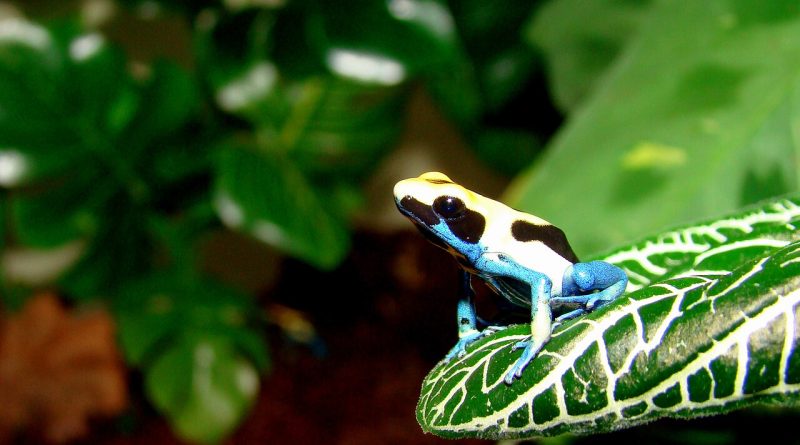
Dyeing Poison Dart Frog: The Frog of a Thousand Colors
Yellow, blue, black, orange, white… the dyeing poison dart frog comes in so many colors that frog lovers collect its forms like stamps. It is one of the largest poison dart frogs, the parent species of the famous blue «azureus», and it carries one of the strangest names in the animal kingdom. At Somos Pacífico, from Colombia’s land of poison frogs, we tell you its story.
Dyeing poison dart frog: quick facts
- Scientific name: Dendrobates tinctorius
- Size: usually 4 to 5 cm (1.6 to 2 inches); some females reach about 6 cm
- Where it lives: the Guiana Shield: French Guiana, Suriname, Guyana and northeastern Brazil
- Diet: ants, termites, small insects and spiders
- Active: during the day
- Lifespan: 10 years or more in captivity, with reports of up to 15
- Conservation status: Least Concern (IUCN)
Why is it called the «dyeing» poison dart frog?
Its name, tinctorius, comes from the Latin word for «dyeing». It refers to an old story from the Amazon and the Guianas. According to early accounts, some Indigenous peoples practiced a technique known as tapirage: they plucked feathers from young parrots and rubbed the skin with substances, including, it was said, secretions from this frog. When the feathers grew back, they came out yellow or red instead of green.
Whether the frog itself really changed the color, or other substances did the work, is still debated. But the legend stuck, and so did the name.
One frog, dozens of colors
The classic dyeing poison dart frog is black with yellow or white stripes and bright blue legs. But from one forest patch to the next, its colors change completely. In the hobby, these color forms are known as «morphs», and some of the best known are:
- Azureus: almost entirely blue with black spots. It was once considered a separate species. Read our full guide to the blue poison dart frog.
- Cobalt: yellow back, black markings and deep blue legs.
- Citronella: a bright lemon-yellow form.
- Giant Orange: large, with orange and black colors.
- Powder Blue: soft light blue with dark spots.
All of them belong to the same species. Their differences come from living in isolated «islands» of forest, where each population developed its own look over thousands of years.
Where does the dyeing poison dart frog live?
It lives in the humid forests of the Guiana Shield, in northeastern South America: French Guiana, Suriname, Guyana and part of northeastern Brazil. It likes damp forest floors near streams, but it also climbs, and it is often seen sitting among vines one or two meters above the ground.
Is the dyeing poison dart frog poisonous?
Wild dyeing dart frogs carry alkaloid toxins in their skin, obtained from the ants they eat. These toxins protect them from predators, and their bright colors advertise it. They are much less dangerous to humans than the deadly Phyllobates of the Colombian Pacific, like the golden poison frog. As with every poison dart frog, captive-bred animals fed on fruit flies and crickets are not toxic.
How do they reproduce?
Mating takes place on land, where the female lays a clutch of around 8 to 10 eggs that the male fertilizes and watches over. When the tadpoles hatch, the male carries them on his back to water: tree holes, bromeliads or small pools. Sometimes several males drop their tadpoles in the same pool. The tadpoles eat almost anything they find, including, at times, each other. They become small frogs after about ten weeks.
One of the most popular pet dart frogs
Because of its size, bold behavior and amazing variety of colors, the dyeing poison dart frog is one of the most popular species among dart frog keepers. It is visible during the day, hardy and long-lived. Collecting wild frogs is illegal in their native countries, and today the hobby is supplied by captive-bred animals. If you are thinking of keeping one, always choose a responsible breeder.
Its relatives in Colombia
The dyeing dart frog lives far from Colombia, but its genus Dendrobates reaches the country through the green and black poison dart frog (Dendrobates auratus), which ranges from Nicaragua into Colombia. And the Colombian Pacific holds the deadliest dart frogs of all. Discover them in our list of the most poisonous frogs in the world.
Frequently asked questions
How big do dyeing poison dart frogs get?
They are among the largest dart frogs: usually 4 to 5 cm, with some females reaching around 6 cm.
Is the blue poison dart frog a dyeing dart frog?
Yes. The blue «azureus» is now considered a color form of Dendrobates tinctorius, although it was described as a separate species for many years.
Can you touch a dyeing poison dart frog?
Wild ones are best left alone, since their skin toxins can irritate or harm. Captive-bred frogs are not toxic, but handling stresses them.
How long do dyeing poison dart frogs live?
In captivity they commonly live 10 years or more, with reports of up to 15 years. Their lifespan in the wild is less well known.
Want to learn more? Read our 15 poison dart frog facts.
Sources: Toronto Zoo; Zoo New England; IUCN Red List; American Museum of Natural History. Featured video by TCS Dart Frogs on YouTube. Featured photo: Pogrebnoj-Alexandroff, CC BY 3.0, via Wikimedia Commons.

Contenido Destacado