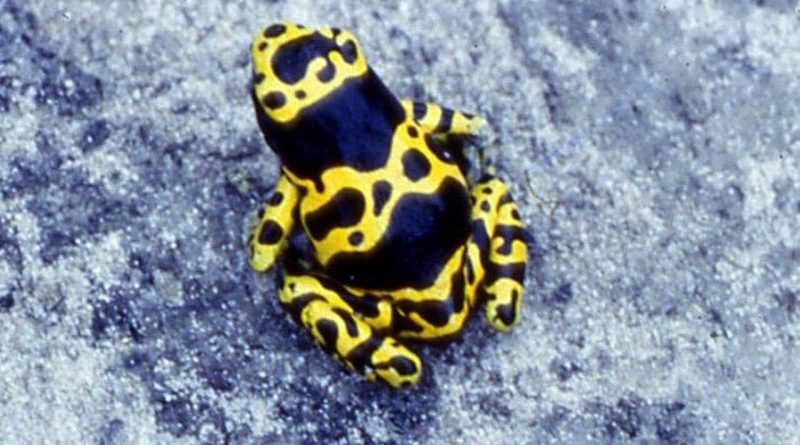
Bumblebee Dart Frog: The Yellow-Banded Poison Frog That Sleeps Through the Dry Season
Bright yellow with bold black bands, it looks exactly like a little bumblebee hopping across the forest floor. The bumblebee dart frog, also called the yellow-banded poison dart frog, is one of the most striking poison frogs in South America, and it has a trick no other poison dart frog is known to use: it can «switch off» during the dry season. At Somos Pacífico, from Colombia’s land of poison frogs, we tell you all about it.
Bumblebee dart frog: quick facts
- Scientific name: Dendrobates leucomelas
- Other names: yellow-banded poison dart frog, yellow-headed poison dart frog; known in Venezuela as «sapito minero»
- Size: about 3 to 5 cm (1.2 to 2 inches); most adults are around 4 cm
- Weight: about 3 grams
- Where it lives: mainly Venezuela, plus parts of Guyana, northern Brazil and the far east of Colombia
- Diet: ants, termites, beetles, small crickets, spiders and other small invertebrates
- Conservation status: Least Concern (IUCN); listed in CITES Appendix II
Where does the bumblebee dart frog live?
It lives in northern South America, mostly in Venezuela, with populations in Guyana, northern Brazil and the far eastern edge of Colombia, near the border with Venezuela. You can find it in humid tropical forests close to fresh water, among rocks, tree trunks, bromeliads and fallen leaves, from sea level up to about 800 meters. It also lives in patches of forest that dry out for part of the year, something unusual for a poison dart frog.
The only poison dart frog that «sleeps» through the dry season
Most poison dart frogs need constant humidity. The bumblebee dart frog is different: it tolerates drier conditions better than its relatives, and when the dry season arrives, it becomes inactive. Frogs gather in damp hiding places, under rocks or fallen trunks, and wait for the rains to return. This kind of dormancy is called estivation, and the bumblebee dart frog is considered the only known poison dart frog to do it.
Is the bumblebee dart frog poisonous?
In the wild, yes. Like other dart frogs, it stores alkaloid toxins in its skin, obtained from the small arthropods it eats. Its yellow and black pattern is a classic warning sign, the same color code used by wasps and bees: «danger, don’t eat me». Its toxins are far weaker than those of the deadly Phyllobates frogs of the Colombian Pacific, like the golden poison frog. Captive-bred bumblebee frogs, fed on fruit flies and crickets, are not toxic.
Each frog has its own pattern
The black markings change from one frog to another: some have thin spots, others thick bands that cross the whole body. A few populations are more orange than yellow. Because the pattern is so variable, keepers can often recognize each frog individually, almost like a fingerprint.
A loud little frog
Bumblebee dart frogs are active during the day and fiercely territorial. Males defend their space with a long, musical trill that is surprisingly loud for such a small animal, as you can hear in the video above. Outside the breeding season they mostly live alone on the forest floor.
How do bumblebee dart frogs reproduce?
Breeding happens with the rains. The female lays her eggs on land, and the male protects and cares for them. After about 10 to 14 days, the tadpoles hatch and the male carries them on his back to small pools of water. There they develop for around 70 to 90 days before becoming tiny frogs.
A favorite of dart frog keepers
Bold, colorful, loud and relatively hardy, the bumblebee dart frog is one of the most recommended species for beginners. Its tolerance for slightly lower humidity makes it a bit more forgiving than other dart frogs, although it still needs a planted, humid terrarium and live food. Captive breeding has made it widely available, which also reduces the pressure on wild populations. Always choose captive-bred frogs.
Frequently asked questions
Does the bumblebee dart frog live in Colombia?
Yes, but only at the far eastern edge of the country, near the border with Venezuela. Most of its range is in Venezuela. The most famous Colombian poison frogs live on the other side of the country, in the Pacific rainforest. Meet them in our list of the most poisonous frogs in the world.
How big do bumblebee dart frogs get?
Between about 3 and 5 cm, with most adults close to 4 cm. Females are usually a little larger than males.
Can you touch a bumblebee dart frog?
It’s best not to touch wild frogs, whose skin toxins can irritate or harm. Captive-bred frogs are not toxic, but handling stresses them.
Why is it called «bumblebee»?
Because of its yellow and black bands, which look like the stripes of a bumblebee and serve the same purpose: a warning to predators.
Want more? Read our 15 poison dart frog facts, or meet its cousins, the dyeing poison dart frog and the green and black poison dart frog.
Sources: IUCN Red List; David Traylor Zoo of Emporia; Wikipedia. Featured video by Tyson West on YouTube. Featured photo: gailhampshire, CC BY 2.0, via Wikimedia Commons.

Contenido Destacado