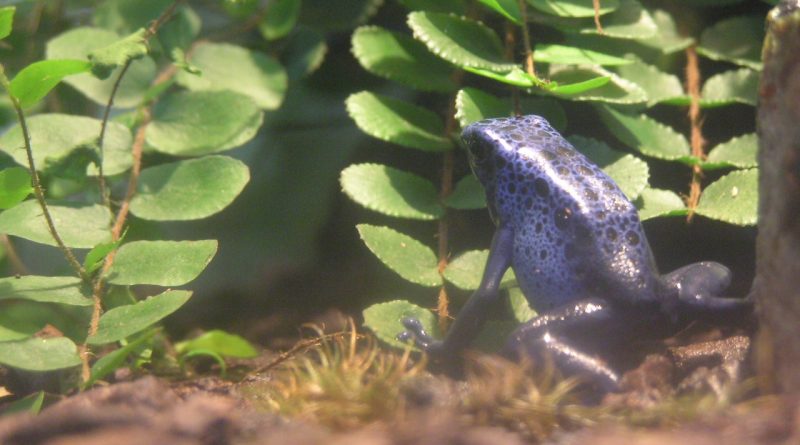
Blue Poison Dart Frog (Azureus): Facts, Habitat and Care
With its electric blue skin and black spots, the blue poison dart frog is probably the most recognizable frog in the world. It appears in documentaries, zoos and countless photos, yet in the wild it lives in only a few small patches of forest in South America. Here at Somos Pacífico, home of Colombia’s poison frogs, we tell you everything about this blue jewel: where it lives, how toxic it is and why it is so popular as a pet.
Blue poison dart frog: quick facts
- Scientific name: Dendrobates tinctorius «azureus» (formerly Dendrobates azureus)
- Size: about 3 to 4.5 cm (1.2 to 1.8 inches); females are slightly larger
- Weight: around 3 grams
- Where it lives: the Sipaliwini savanna in southern Suriname, reaching into northern Brazil
- Active: during the day
- Lifespan: about 4 to 6 years in the wild; around 10 years, and up to 12, in captivity
- Toxic? Wild frogs are; captive-bred frogs are not
Is the blue poison dart frog its own species?
For years it was. Scientists described it as Dendrobates azureus, a separate species. Later genetic studies showed that it is very close to the dyeing poison dart frog (Dendrobates tinctorius), a species famous for having many color forms. Today the blue frog is usually treated as one of those forms, written as Dendrobates tinctorius «azureus». Among hobbyists and zoos, the name «azureus» is still the most common.
Where does the blue poison dart frog live?
Its home is unusual. The blue poison dart frog lives in the Sipaliwini savanna, in the far south of Suriname, with a small part of its range crossing into Brazil. It is a dry, grassy landscape, but scattered across it are small «islands» of humid forest, between about 315 and 430 meters above sea level. The frogs live inside those islands, in dark, damp spots near small streams and moss-covered rocks.
Because each forest island is isolated by savanna, the frog’s populations are small and separated from one another. That makes them vulnerable to any change in their habitat.
How poisonous is the blue poison dart frog?
Wild blue frogs carry alkaloid toxins in their skin, enough to make a predator very sick. Their bright blue color is a warning: «don’t eat me.» But they are far less dangerous to people than the champions of toxicity, the Phyllobates frogs of the Colombian Pacific, such as the golden poison frog. You can see how they compare in our list of the most poisonous frogs in the world.
Like all poison dart frogs, the blue frog does not make its own poison. It gets the toxins from the ants and other small invertebrates it eats in the wild. That is why captive-bred blue frogs, fed on fruit flies and crickets, are not poisonous.
Behavior: small, blue and very territorial
Blue poison dart frogs are active during the day and move in short hops, rarely far from water. They are bold and surprisingly aggressive. Males defend their territory with calls, chases and even wrestling matches against other frogs, and females can be just as feisty. Most of the time they stay on the ground, although they have been seen climbing up to 5 meters into the trees.
How do blue poison dart frogs reproduce?
Breeding usually happens in the rainy season. Males call from a leaf or rock, and it is the females who compete for them. The female lays a small clutch of eggs on land, usually between 5 and 10. The male is the main caretaker: he watches over the eggs and, when the tadpoles hatch, carries them on his back to small pools of water in tree holes, leaf axils or bromeliads. Tadpoles take around 10 to 12 weeks to become tiny frogs.
How to tell males from females
This is one of the most searched questions by people who keep them. Females are usually a bit bigger and rounder, with a more hunched back. The best clue is in the toes: males have larger, heart-shaped toe pads, while females have smaller, rounder ones.
What do blue poison dart frogs eat?
In the wild they hunt small prey with their sticky tongue: ants, termites, tiny beetles, mites, spiders and flies. In captivity they are usually fed fruit flies, small crickets and springtails, often dusted with vitamin and calcium supplements.
Is the blue poison dart frog endangered?
The dyeing poison dart frog as a whole is listed as Least Concern by the IUCN, but that assessment covers a wide species. The blue form lives in a tiny, fragmented area, and it has been heavily collected in the past for the pet and zoo trade. Deforestation and climate change, which could dry out its forest islands, are also threats. Today, captive breeding in the United States and Europe supplies much of the demand, which helps take pressure off wild populations.
The blue frog’s cousins in Colombia
The blue poison dart frog does not live in Colombia, but its genus does. The green and black poison dart frog (Dendrobates auratus) ranges from Nicaragua to Colombia, and the Colombian Pacific is home to some of the most spectacular poison frogs on Earth. Discover more in our poison dart frog facts.
Frequently asked questions
Can you touch a blue poison dart frog?
A wild one, it’s best not to: its skin toxins can irritate or harm you if they reach a cut or your eyes. Captive-bred frogs are not toxic, but handling stresses them, so keepers avoid it.
Are blue poison dart frogs good pets?
They are one of the most popular dart frogs in the hobby because they are bold and often visible. They need a humid planted terrarium, live insects and steady temperatures. Always choose captive-bred animals from a responsible breeder.
Why is the blue poison dart frog blue?
Its color is a warning signal, known as aposematism. Predators learn to associate bright colors with a bad-tasting, toxic meal and leave the frog alone.
Sources: Toronto Zoo; Aquarium of the Pacific; American Museum of Natural History; IUCN Red List. Featured video by Encounters with Nature on YouTube. Featured photo: Frank Wouters, CC BY 2.0, via Wikimedia Commons.

Contenido Destacado