Poison Dart Frog Facts: 15 Things You Probably Didn’t Know
They are the size of a coin, they come in every color of the rainbow, and some of them carry enough poison to kill several people. Poison dart frogs are among the most fascinating animals in the rainforest. At Somos Pacífico we live in the Colombian Pacific, the region that is home to the most poisonous of them all, so we put together the facts that people ask about most.
Poison dart frog facts at a glance
- Family: Dendrobatidae
- Number of species: close to 200 described, and new ones are still being discovered
- Where they live: rainforests and cloud forests of Central and South America, from Nicaragua to Bolivia and southern Brazil
- Size: most are 2 to 4 cm (0.75 to 1.5 inches); the largest reach about 6 cm
- Active: during the day
- Most poisonous species: the golden poison frog, from Colombia
- Lifespan: around 5 to 12 years or more in captivity; little is known about the wild
1. They don’t make their own poison
This is the fact that surprises people most. Poison dart frogs get their toxins from what they eat: ants, mites, small beetles and other tiny invertebrates of the forest floor. Their bodies store the alkaloids from that prey in glands in their skin. Studies of their diet show that toxic species eat far more ants than non-toxic ones.
2. Pet poison dart frogs are not poisonous
Because the poison comes from wild prey, frogs bred in captivity and fed fruit flies and crickets never become toxic. That is why zoos and hobbyists can keep them safely. Interestingly, a frog caught in the wild can keep its toxins for years after it is taken out of the forest.
3. Only three species were used for poison darts
The whole family is called «poison dart frogs», but only three species are known to have been used to poison blowgun darts, all of them from the Colombian Pacific: the golden poison frog, the black-legged poison frog and the Kokoe poison frog. Indigenous hunters of the region, such as the Emberá, coated their dart tips with the frogs’ secretions. Read more in our list of the most poisonous frogs in the world.
4. The most poisonous one could kill about ten people
The golden poison frog (Phyllobates terribilis) carries about one milligram of batrachotoxin, commonly described as enough to kill around ten adults. Batrachotoxin keeps the sodium channels of nerves and muscles open, so the body can no longer control its signals. There is no known antidote.
5. Most poison frogs are not deadly to humans
The deadly reputation belongs to a handful of species. Many poison frogs have toxins that are unpleasant or harmful to predators but not lethal to people, and some species are not toxic at all and have dull brown colors. Still, the rule with any wild frog is the same: look, don’t touch.
6. Their bright colors are a warning
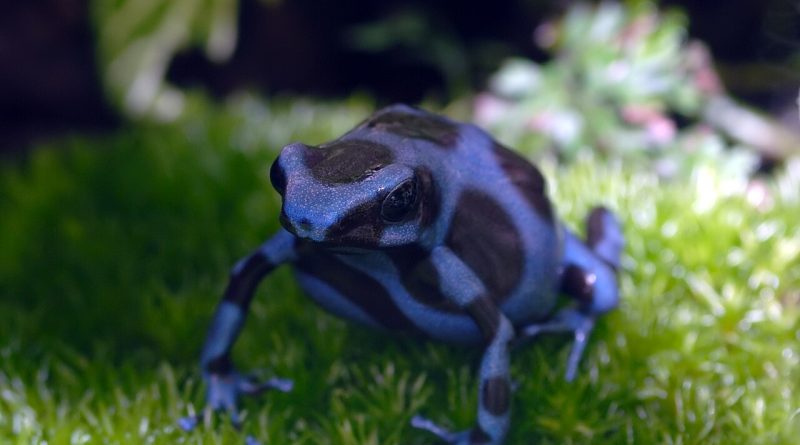
Yellow, red, blue, orange, green: these frogs want to be seen. Scientists call it aposematism, or warning coloration. A bird that tries to eat one learns quickly that bright colors mean a terrible meal. As a general rule, the most colorful species tend to be the most toxic.
7. One species can come in many colors
Many species have several color forms, called morphs, depending on where they live. The golden poison frog can be yellow, orange or mint green. The strawberry poison dart frog has dozens of morphs, from red with blue legs to green, orange and spotted forms. The harlequin poison frog of the Colombian Chocó is so variable that almost no two look alike.
8. They are devoted parents
Poison dart frogs lay their eggs on land, in moist leaf litter, and a parent (often the male) guards them. When the tadpoles hatch, they climb onto a parent’s back and are carried, sometimes one by one, to tiny pools of water: the center of a bromeliad, a hole in a tree, even an empty Brazil nut shell. In some species the mother comes back every few days to lay unfertilized eggs so her tadpoles have something to eat.
9. Their scientific name means «tree walker»
The genus Dendrobates comes from the Greek dendro (tree) and bates (walker). It is a funny name, because many poison frogs spend most of their time on the forest floor. Even so, they are excellent climbers, especially when carrying their tadpoles up into the trees.
10. They are active during the day
Most frogs hide during the day and come out at night. Poison dart frogs do the opposite. Protected by their toxins and warning colors, they don’t need to hide, so they hunt, call and court in daylight. Males usually call early in the morning to defend their territory.
11. Their toxins are helping medicine
Frog alkaloids have become valuable research tools. Batrachotoxin is used to study how nerves work. Epibatidine, found in a small frog from Ecuador, proved about 200 times more potent than morphine as a painkiller in laboratory tests. It was too toxic to use as a medicine, but it inspired the search for new pain drugs.
12. There are poison dart frogs in Hawaii
Not naturally. In 1932, green and black poison dart frogs (Dendrobates auratus) were introduced to the island of Oahu, and a population still lives there today, thousands of kilometers from their native forests.
13. Colombia is the kingdom of poison frogs
Colombia is one of the most frog-rich countries on Earth, and its Pacific rainforests hold some of the most spectacular poison frogs: the golden, black-legged, Kokoe, harlequin and Lehmann’s poison frogs, among others. Several of them live nowhere else in the world.
14. Many species are in danger
Many poison frogs have tiny ranges, sometimes just a few square kilometers of forest. Deforestation, illegal mining and wildlife trafficking put them at risk, and several Colombian species are listed as Endangered or Critically Endangered by the IUCN. A 2024 study led by the Wildlife Conservation Society found that frogs of the genera Oophaga, Phyllobates and Andinobates are declining partly because of illegal collection for the pet trade.
15. You can help them
If you love these frogs, the best thing you can do is never buy an animal that may have been taken from the wild. Choose captive-bred frogs from responsible breeders, support conservation organizations working in the Chocó rainforest, and if you visit Colombia, see them in their forest with a local guide.
Frequently asked questions
Are poison dart frogs dangerous to touch?
Wild ones can be. The most toxic species can harm you if their secretions reach a cut or your eyes or mouth. Captive-bred frogs are not toxic, but handling stresses them and should be avoided anyway.
How big do poison dart frogs get?
Most species measure between 2 and 4 cm. The largest, like the golden poison frog and the dyeing poison dart frog, can reach around 5 to 6 cm.
What do poison dart frogs eat?
In the wild, ants, termites, mites, small beetles, springtails and other tiny invertebrates. In captivity, mainly fruit flies and springtails, which is why they lose their toxicity.
Where do poison dart frogs live?
In the humid forests of Central and South America, from Nicaragua to Bolivia and Brazil. The most poisonous species live in the Chocó rainforest of Colombia’s Pacific coast.
Sources: American Museum of Natural History; Wildlife Conservation Society Colombia (study in Conservation Science and Practice, 2024); IUCN Red List; New World Encyclopedia. Featured video by BBC Earth on YouTube. Featured photo: André Karwath, CC BY-SA 2.5, via Wikimedia Commons.

Contenido Destacado